
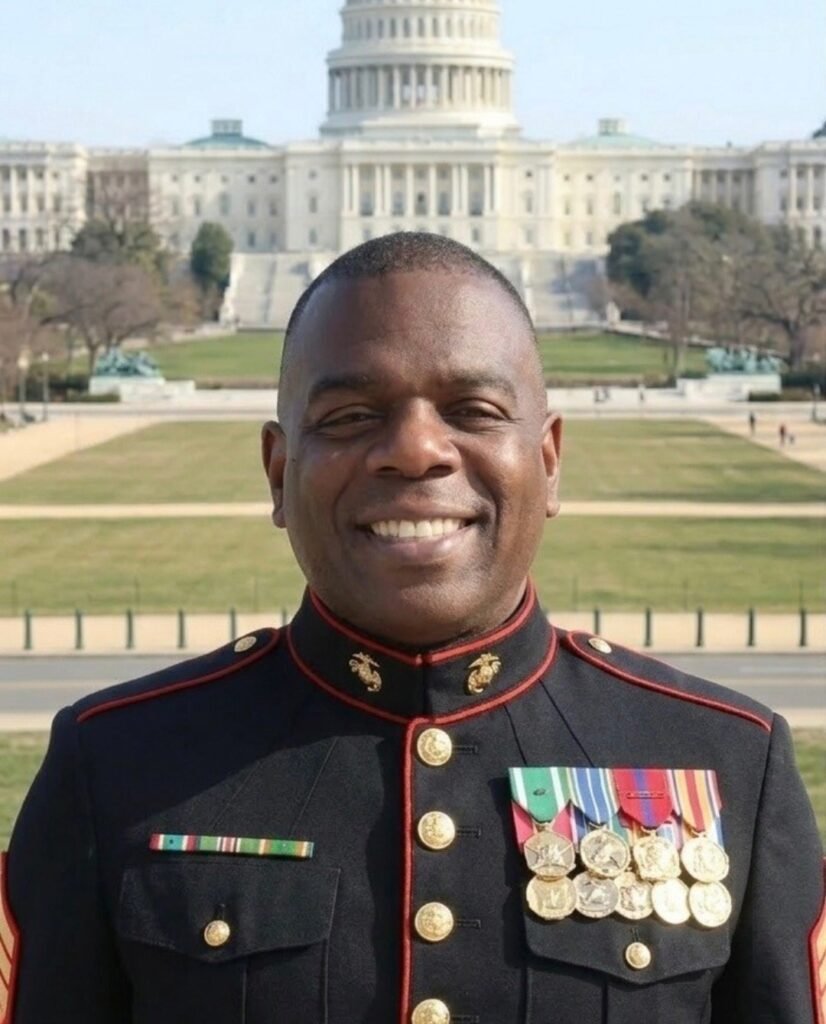
A SPECIAL MESSAGE FROM JAMES HENRY
A SPECIAL MESSAGE FROM COREY WALTON
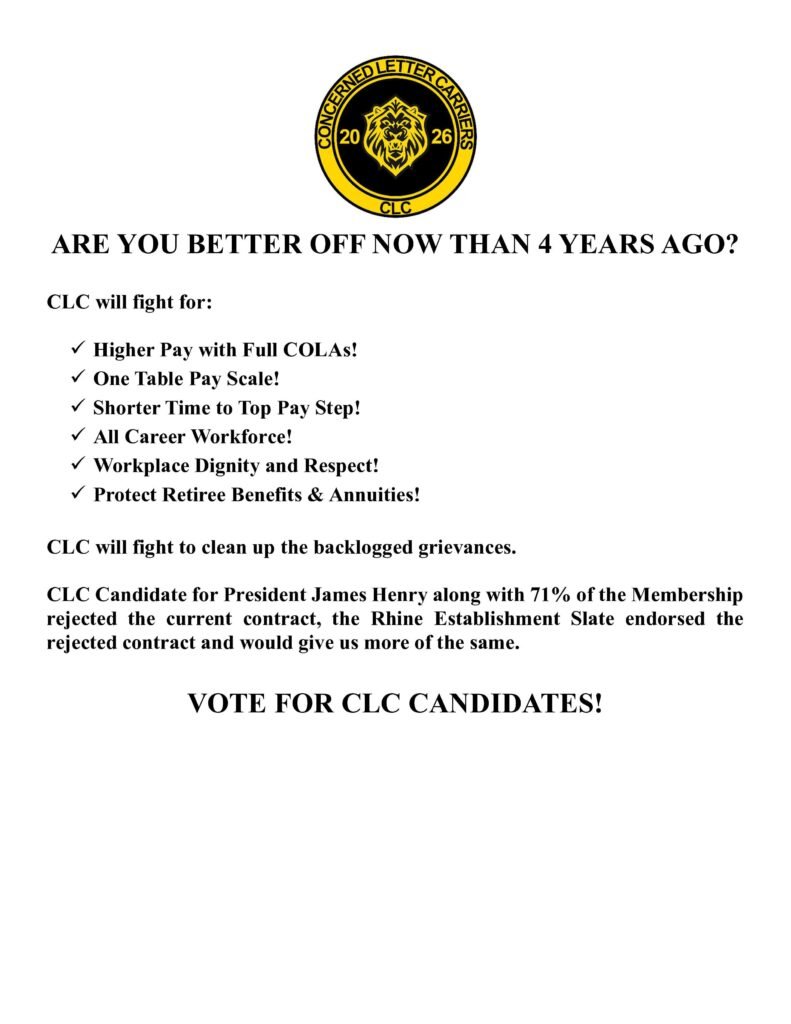
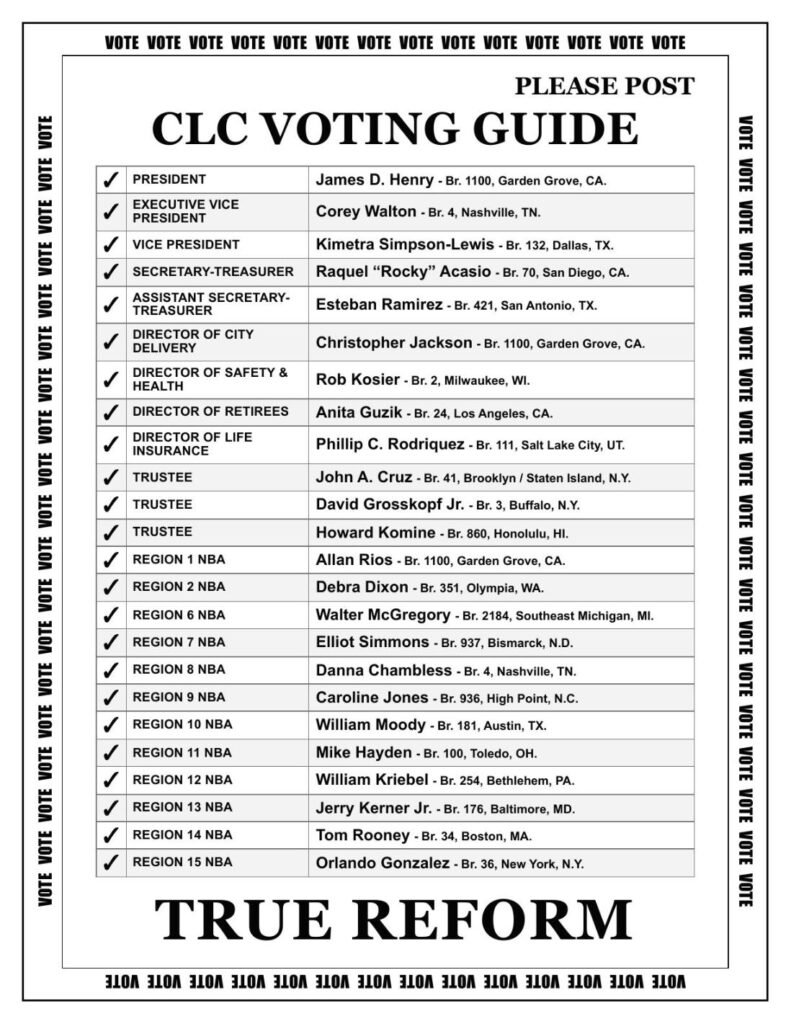
The concerned letter carriers platform
A Two-Tier Pay Structure and pro-rated cola is Bad for Unions
There can be no greater bargaining priority than abolishing the two-tier pay structure and pro-rated COLAs. Not only does a two-tier pay structure undermine solidarity among workers, but it also weakens the bargaining power of the NALC by fostering resentment and division within the membership. When Letter Carriers do the same job, but receive different wages and benefits based solely on their hire date, the sense of unity that is essential for effective collective action is eroded. As a result, the Union has found it increasingly difficult to mobilize its members. History has proven it has compromised our ability to advocate fair treatment and equitable compensation for all. This fragmentation caused by a two-tier wage can also give management greater leverage, making it easier to implement unfavorable policies, and resist the rank & file demands for improvement –thus jeopardizing the long-term strength and influence of the Union.
Another item of great concern is the pro-rated COLA. This pay disparity also undermines the fundamental principle of equal pay for equal work and creates an environment where fairness within the Union is called into question. Over time, such divisions erode trust between the membership and Union leadership. Addressing these issues head-on is crucial to maintaining the integrity and unity that are the hallmarks of a strong Union.
Furthermore, the existence of a two-tier pay system and pro-rated COLA has proven itself to be a discouraging factor for new hires to fully engaging in Union activities as it is obvious they feel marginalized and less valued compared to their more senior Letter Carrier’s. This not only hampers efforts to build a cohesive and motivated membership but also poses challenges for sustaining membership. Ultimately, eliminating these disparities is essential for restoring trust, morale, and collective strength within the union. It is astonishing that the current leadership of the NALC has not commented on the seriousness of such a division within our Union.
Grievance Backlog
- Activate sufficient teams to the DRT to clean up backlog at this level.
- Add enough arbitrators to the regional panels so that output of settlements and decisions equals or exceeds input of grievances appealed to arbitration.
NALC HEADQUARTERS REFORMS
Main Table Bargaining Committee, made up of the President, and at a minimum of two other Executive Council members. This creates a redundancy system if one component of the bargaining committee goes down, there’s two others who don’t have to start from scratch.
- That the committee be required to give frequent detailed reports to the Executive Council of meetings, when they took place, who was met with and what was discussed.
- Will direct the Executive Council to establish an attendance control policy requiring all officers to request leave for absences and authorization for travel.
- That the policy addresses how all officers request FMLA and if necessary, reasonable accommodation for work.
- Will direct the Executive Council to establish a sexual harassment policy that applies to all National Officers of the NALC.
- Will direct the Executive Council to establish a NALC driving privilege policy requiring all officers to have a valid driver’s license and insurance to drive. That the policy applies to NALC owned vehicles, rented vehicles or if reimbursement is requested for business travel.
- Transparency, being the key ingredient, for I will lift the veil of secrecy that surrounds National Headquarters. I will ensure that Executive Council minutes and financial reports will be published in the Postal Record.
BUILD A FIGHTING NALC
REESTABLISH A DIRECTOR OF EDUCATION
- We will launch a Steward’s Academy, offering a comprehensive on line learning platform on a diverse range of subjects. The NALC Advocate and Arbitration Advocate will resume. It’s going to take well-educated stewards and officers to face the challenges of today and in the future. By developing a well-trained and talented pool we’ll create opportunities for Rank-and-File members to become Shop Stewards, Arbitration Advocates, NALC Step B Representatives, GRA’s, RAA’s and leaders of the future.
ESTABLISH A DISPUTE RESOLUTION TASK FORCE
- We must have a creditable Dispute Resolution Process that is just and swift. Currently there are over 15,000 grievances backlogged at Step B and 5,000 cases pending arbitration. This did not happen overnight. Obviously the 59 teams currently in place are inadequate to deal with the backlog and as new cases keep coming in, more Teams are needed and that will happen. However, the NALC responsibilities for the DRT process are not specific to the STEP B and Arbitration process. The 15,000 backlogged grievances at Step B are just the tip of the iceberg, there are thousands of grievances backlogged at Steps A and Informal A. My experience as a Branch Officer and as Chief Instructor for the NALC’s Formal A and Beyond training tells me that we have a vast reservoir of talent and sophistication within the rank and file, with that said –we can develop a force of aggressive advocates breaking the backlog, protecting the rights of Letter Carriers, and improving working conditions. We will always be mindful that “Justice delayed is Justice denied”.
HOSTILE WORK ENVIRONMENT ABATEMENT
- The use of electronic supervision has caused a significant decline in our working conditions and has given management tools to covertly conduct street observations. It’s not that our current leadership doesn’t recognize the daily torment caused by electronic supervision, it’s that they chose to ignore it and view it as a mere inconvenience. We will establish firm contract provisions with forbid the use of any kind of electronic device to supervise, conduct observations, or use for discipline.
- We will create task forces of well-trained and aggressive Advocates to intervene in those work sites with hostile environments in order to eliminate the harassment, bullying, intimidation, and manipulating of Letter Carriers. The initial focus of these task forces will be to address environmental issues with every resource in the book. We will spread the net of responsibility as far and as wide as needed to uproot the enablers who permit abusive managers to remain on the workroom floor. Once that process is under way, we will focus on training local Shop Stewards and Officers to aggressively engage at every level of management until all City Letter Carriers are treated with dignity and respect.
ESTABLISH AN ORGANIZING DIRECTOR
- We will create a structure that taps into the positive public perception of Letter Carriers and seeks their support for our cause. We will provide training for local organizers and support direction action where the rank and file are a part of the bargaining process. Both National and Regional Organizers will work with Branches to motivate involvement and drive turn out. They will also have the responsibility to work with Branches in making the community aware of the issues facing City Letter Carriers.
MAKING LETTER CARRIER SAFETY A PRIORITY
- Letter Carriers are being robbed and assaulted in record numbers. Speeches and marches have done little to stem the ever-increasing number of crimes committed on Letter Carriers. It’s time for full court press, our legislative department needs to be involved with local officials to increase police presence and quicker response times. Legislation needs to be passed to provide for substantial rewards for information leading to the arrest of those who rob and assault Letter Carriers. Our Director of Safety will work with the USPS to develop training for Letter Carriers and managers. An emergency device feature on the scanner needs to be added that can notify local police immediately of a robbery or assault and the location. We need access to trauma counselors. If necessary, organize a continual direct action campaign to spur local officials to lend greater support, community awareness and demand that the USPS curtail delivery in high crime areas.
Principled Contract Negotiations
To Understand the possibilities, you need to understand where we are. The U.S. Postal Service reported a record high in revenue last year of 72 billion dollars, it also reported a loss of 6 billion. A very dramatic shift has taken place within the Postal Service which has caused the role of City Letter Carriers to evolve with social change. Mr. & Mrs. Jones on ELM Street in Anytown USA are paying their bills online, communicating with family and friends on social media and are shopping online. Unfortunately, this has caused first class letter mail volume to drop 50% of what it was just a few years ago. However, we have become the shipper of choice for the almost 6 trillion-dollar E-commerce industry. Expectations are for industry growth for years to come… which means City Letter Carriers will play an essential role in this new segment of the economy thereby providing job security. You must look no further than the Sunday work schedule to see the impact the E-commerce industry has had on City Letter Carriers.
Nobody saw this coming back in the 1990’s when doom and gloom predictions permeated throughout the USPS and the NALC. This mind set caused contract concessions and interest arbitration losses during some very difficult economic times over the past few years. In 1990 you hired in as a career City Letter Carrier, today you must endure being a CCA for two years on fast food workers’ wages and few benefits before career status. In 1984 it took eight years to reach top salary and today it takes almost 13 ½ years. In 1990 non-career casual employees were restricted to 5% of the work force and only two 90-day terms. Today non-career CCAs make up 15% per district, plus another 8,000 nationwide. The employer has gone from paying 76% of the cost of health care to 72% passing that cost onto the backs of Letter Carriers. Regardless of how these and other losses took place, it’s time to take them back. City Letter Carriers deserve to be industry leaders in pay, benefits and working conditions. We will start by correcting the injustices inflicted on this generation of City Letter Carriers by the two-tier pay structure. We will work tirelessly to close the wage disparity and reduce the time it takes to reach top salary. One Union, one pay structure!
Contract negotiations cannot be about giving something up in one area to gain in another, simple logic dictates that there is only so much you can give back before there’s nothing left. Therefore, I will refrain from modifying our contract by memos and advocate for new contract language when necessary. Furthermore, I will never ever agree to any program or process that is non-grievable. Contract negotiations must be about the value of our labor. As an example, the Teamsters recognized UPS role in this new economy and achieved a significant victory by placing a value on the value of their labor.
- TIAREAP: TIAREAP is perhaps the most controversial change suggested for the National We cannot allow ourselves to be caught between two false choices, TIAREAP or Chapter 2 of the M-39 …there’s an obvious third option of going back to the drawing board. TIAREAP contains too many give backs and lacks sufficient protections for the rank-and-file Letter Carrier. Chapter 2 of the M-39 is from a bygone era when letter volume was twice of what it is today. The USPS’s need to modernize the route evaluation process that puts the NALC in the driver’s seat. It is possible to negotiate a process that doesn’t require us to give up our Article 15 rights to file a grievance, or our right to special route inspections. We don’t need an electronic leash that holds us accountable for every minute of the day to have a fair adjustment process. Current NALC leadership seems to be so blinded by their ambition to create a new process that they are intentionally deaf to management applying their so-called parameters as standards for loading time and street functions –which is leading to a deterioration of working conditions. Discipline for stationary events is on the rise, which relies on circumstantial evidence gathered by covert electronic means. The Union cannot be the facilitators of management’s mayhem. We are opposed to any inference of a street standard for Letter Carriers. I am very confident that the NALC can come to an agreement that properly adjusts a Letter Carrier’s assignment to as close to eight hours as possible without giving away the store.
- Escalating Remedies for contract violations: Escalating remedies isn’t a bad thing… repeated and continual contract violations is a bad thing. The current administration has a genuine lack of empathy for the level of frustration within the rank-and-file caused by management’s continual violation of work rules including distribution of overtime, number of hours worked, and inappropriate & sometimes cruel behavior of management. The calculus is simple –stop violating the contract or face ever increasing remedies until upper management can find someone to run a station without violating the contract. If we are to improve working conditions, we need the tools in the contract that facilitate holding management accountable.
- City Letter Carrier Uniform Allowance: City Letter Carrier uniforms shouldn’t cost as much as designer clothing. It is also true that whatever amount a City Letter Carrier receives for their uniforms the cost will rise It’s time to get off the hamster wheel. With corporate mergers and buy-outs the number of uniform companies has been reduced to a point where there is no competition and they can charge whatever they want, leaving City Letter Carriers with worn out shoes/uniforms and nothing to protect them from the elements. Each Letter Carrier gets $499 per year in uniform allowance, with over 280,000 active City Letter Carrier that equates to approximately $139,720,000.00 per year in bargaining power. It stands to reason that an exclusive contract that specifies uniform cost would reduce margins for such a potential revenue stream. Another area that deserves attention is the initial allotment. Consideration should be given to provide the first set of uniforms at no cost, where each City Carrier is issued all the uniform items necessary with special consideration for areas with adverse weather conditions.
- Staffing and Excessive Work Hours: After years of mutual understanding that the 12/60 work hours limit was supposed to be a hard stop maximum work hour limit, management has “Flipped the Script”. Today Letter Carriers are being forced to work beyond the maximum limits as much as 16 hours per day –more in some cases– because of improper staffing. It’s not even a shared sacrifice because management will take Letter Carriers off the floor as 204-B’s and make them closing supervisors so management can maintain their eight-hour day. In other cases, management will detail carriers from one office to another which causes forced overtime issues in the losing station. It’s obvious that management is being willfully negligent… forced overtime being a strategy. Rather than taking up the fight over proper staffing, the previous and now current administration signed a memorandum of understanding (M-01968) which facilities management’s understaffing strategy. Rather, than taking up the fight in support of escalating remedies for overtime violations, the current administration sees them as punitive and a bigger problem than the violation itself. Now the Renfroe administration has floated the idea of removing the overtime caps to allow you a right you already have, not to work beyond 12/60. The current administration approach is typical of weak “hat in hand” give back negotiations. As your President, I will ensure the enabling memo M-01968 is withdrawn post-haste. I will direct the Executive Council to submit three resolutions to be brought before the convention delegates seeking contract language requiring carrier delivery units to be properly staffed, giving Letter Carriers the right to refuse to work beyond 12 hours and “cease and desist” language with escalating remedies be included in the National Agreement. Our collective experience with Postal Service has taught us that if the Union is not a lion…carriers are prey.
The four items mentioned are not exclusive, but they do give you some insight into a solution-based approach for some very difficult and complex problems faced by Letter Carriers. The NALC has a unique process which enables the rank-and-file member to submit contract resolutions to the convention for consideration. At times in the past the Executive Council has taken a rather heavy hand in their approach to many of these resolutions. To the extent possible we should strive to moderate that response and work diligently to incorporate these items into our bargaining position. In addition to publishing the NALC bargaining position during negotiations, I will ensure frequent bulletins, and provide updated podcasts outlining the Union activities on your behalf. I will call on the membership for a demonstration of solidarity and support for our bargaining objectives. In short, whether or not the Open Bargaining resolution passes, we can follow its intent and spirit to the extent circumstances will allow.

CLC DIRECTOR OF SAFETY AND HEALTH
A SAFER FUTURE FOR EVERY LETTER CARRIER
Rob Kosier
Candidate for NALC Director of Safety and Health
Safety is more than preventing injuries. It is building a workplace where every carrier feels safe, respected, supported, and empowered to speak up.
01
DOGS OF WAR - NATIONAL EXPANSION
Create trained advocates in all 15 regions to confront bullying, intimidation, harassment, retaliation, and toxic workplaces. Branches should have experienced backup, standardized tools, and a clear path to action.
02
PEER SUPPORT THAT RESPONDS FAST
Train trusted NALC volunteers as peer responders – not counselors – who can listen, recognize warning signs, stabilize the moment, and connect members to professional help before a crisis becomes a tragedy.
03
HEAT & EXTREME WEATHER ACTION
Build Regional Weather Safety Teams and push stronger national protections for heat, cold, storms, wildfire smoke, air quality, emergency communication, acclimatization, hydration, cooling, and dangerous-weather protocols.
04
CPR, AED & FIRST-AID TRAINING
Expand voluntary access to CPR, AED, and basic first-aid certification. Letter carriers are in communities every day; giving members lifesaving skills can protect coworkers, customers, families, and the public.
protect. prevent. support. enforce.
carrier compassion foundation
Build a nationwide carriers-helping-carriers network for members facing devastating personal hardships – emergency financial assistance, practical support, local compassion coordinators, and national partnerships.
article 14 & safety enforcement
Give stewards and branches stronger training, grievance tools, PS Form 1767 education, OSHA awareness, investigation support, and national guidance. Safety rights mean little if we do not know how to enforce them.
inside the post office
Address hazards inside postal facilities – especially asbestos – along with mold, poor air quality, HVAC failures, electrical and fire hazards, unsafe floors, docks, lighting, machinery, sanitation, and other building conditions.
the everyday hazards still matter
Keep relentless focus on dog attacks, assaults and robberies, vehicle safety, slips and falls, unsafe equipment, and other preventable hazards. Modernizing Safety and Health does not mean abandoning the basics.
what this platform looks like in action
A national department that is visible, responsive, connected to the workroom floor, and ready
to help branches solve problems before another carrier becomes a statistic.
1
every branch deserves backup
2
prevention before reaction
No branch should have to reinvent the wheel. National and regional teams should provide proven tools, experienced advocates, and practical support when serious safety or workplace problems arise.
Use reporting, trend analysis, regional communication, and lessons learned to identify hazards early – not after an injury, assault, heat illness, or workplace crisis.
3
training members can actually use
4
respect is a safety issue
Expand practical training for stewards, safety representatives, branch officers, and interested carriers: Article 14, Joint Statement enforcement, investigations, CPR/AED, first aid, weather safety, and peer support.
A workplace filled with fear, bullying, retaliation, or intimidation is not a safe workplace. Dignity and respect must be treated as essential parts of Safety and Health.
5
national standards, local strength
6
leadership that shows up
Connect all 15 regions, share successful strategies, standardize core materials, and still give local branches the flexibility and support they need to respond to their members.
National safety leadership should listen to carriers, visit installations, engage branch leaders, learn from successful local programs, and stay connected to what members are actually experiencing.
my priorities
Safer workplaces | Asbestos & facilies hazards | Stronger Joint Statement enforcement | Dogs of War in every region | Peer support
CPR/AED training | Heat and weather safety | Carrier compassion | Accountability
why i am running
Because I believe we can do better. We already have good people throughout this union doing incredible work. My goal is to connect them,
train them, give them the resources to succeed, and build systems that protect our members before tragedy happens.
Every carrier deserves to go home safe.
Every carrier deserves to be treated with respect. Every branch deserves the resources to
stand up and fight when those principles are threatened.
mental health & carrier support
no carrier should have to struggle alone!
Safety is not only about preventing physical injuries. Mental well-being belongs in Safety and Health too. A carrier who reaches out for help deserves urgency, dignity, compassion, and a clear path forward.
What we will do:
01
carrier-to-carrier peer support
02
a clear path to help
Train trusted NALC volunteers in all 15 regions as peer responders – not therapists – who can listen, recognize warning signs, respond appropriately, and connect members with qualified professional help.
When a carrier says, “I need help,” they should not be handed a list of numbers and left on their own. Build a nationally coordinated way for members and branches to find credible resources and know what to do next.
03
strengthen emergency response team support
04
train our union to recognize the signs
NALC already has Emergency Response Teams (ERT) that respond when members and branches face traumatic events and emergencies. Strengthen those teams, expand awareness of their support, and make sure every branch knows how to activate them. After robberies, assaults, serious accidents, workplace violence, a coworker death or suicide, and other traumatic events, connect affected carriers with ERT resources and broader peer-support and mental-health efforts.
Give stewards, branch officers, safety representatives, and interested members practical training to recognize warning signs, start difficult conversations, understand the limits of their role, and connect a member with professional help.
05
fight the conditions hurting our members
06
professional partnerships & prevention
Mental-health support cannot mean giving someone a phone number and sending them back into the same toxic environment. When bullying, intimidation, harassment, retaliation, fear, or abusive workplace conditions contribute to distress, we fight those conditions too.
Connect peer responders and branches with credible professional and community resources, learn from serious workplace crises without violating privacy, and use those lessons to improve training, intervention, and prevention.
we protect the whole carrier
We cannot call ourselves a Safety and Health Department if we protect the body while ignoring the person.
When a carrier reaches out for help, somebody should reach back.

CLC DIRECTOR OF RETIREES
Agenda For Progress
Anita Guzik, Candidate for NALC Director of Retirees
BE ACCESSIBLE
The Director of Retirees should be focused on ensuring current and future NALC retirees receive support they need. The NALC web page currently lists the NALC Retiree Departments hours as Monday, Wednesday, and Thursday between 10 am and noon and 2pm to 4 pm on the 800 number. I am committed to expanding the hours of availability for all time zones. In addition, establish a 24/7 online retiree rapid response platform.
RETIREMENT PLANNING
All active Letter Carriers are future retirees. Active Letter Carriers need opportunities to gain a better understanding of their retirement and TSP benefits. Retirement planning is essential for a prosperous and secure retirement.
STRIVE TO NEGOTIATE & IMPLEMENT PHASED RETIREMENT INTO USPS
OPM published final regulations to implement phased retirement on August 8, 2014. Federal Agencies began using phased retirement on November 6, 2014. The Federal Phased Retirement Program allows eligible full-time civil service employees to transition into retirement by working a 50% part-time schedule while receiving 50% of their salary and a partial retirement annuity, backed by mandatory mentoring provisions. Participation is voluntary and requires mutual agreement between the employee and their employing agency. Employees in a phased retirement status continue to work on a part-time basis and draw partial retirement benefits during their continued employment. Phased retirees must commit 20 percent of their new part-time work schedule to mentoring activities as outlined in the phased retirement guidelines.
OPM RETIREMENT BACKLOG AND PROCESSING DELAYS
A Three to Five months delay in processing retirement application is unjust for those who have loyal and faithfully served for decades. Federal employees frequently encounter recurring challenges when applying for or receiving OPM retirement benefits, including processing delays and customer service issues. The NALC Retirement Department will be there to help you navigate the complex and bureaucratic system that’s OPM. The Retiree Department will be committed to be responsive to a very frustrating situation. In addition, will take a proactive approach by providing training at the Regional and Branch level to assist with retirement process with the goal of eliminating application errors.
CREATE A JOINT RETIREE DEPARTMENT AND NALC HEALTH BENEFIT TEAM
To assist retirees better understand and get the most out of their NALC health benefits and Medicare part B. In addition, work with the NALC Legislative Department to lower the cost of Health Care.
LEGISLATION
Two NALC legislative priorities directly affecting current and future retirees are stalled in committee this session of Congress—and that is unacceptable. The Federal Retirement Fairness Act HR 1522 if passed provides approximately 132,000 Letter Carriers who worked in non-career positions to receive retirement credit for time spent as a TE, CCA, or casual. And, I believe that active Letter Carriers who buy back this time should also receive a like amount of time towards their step increases. The Equal COLA HR 491/S 624 Act would correct the current inequity of CSRS Retirees who get FULL COLA while FERS employees do not. This is not fair. Both Bills have an impact on current and future retirees and deserves greater attention than they received. There are 435 House Members (218 Republicans, 212 Democrats and 1 Independent). It is inexcusable that the best we can do is get 157 co-sponsors for the Federal Retirement Fairness Act and 86 co-sponsors for the Equal COLA Act. My experience as Legislative Activist coupled with years spent as a State Officer in Michigan and California gives me the insight needed to shepherd important retiree Bills into laws.
EROSION OF RETIREMENT BENEFITS
Today, Letter Carriers contribute 4.4% of their base pay to FERS retirement, while USPS contributes 10.9%. Just a few years ago the employee contribution was 0.08% and the USPS was 11.3% of base pay. At the same time costs have gone up Letter Carrier pay has dropped dramatically by $14,000 per year for entry level Letter Carriers. This represents the difference in starting pay between table 1 and table 2. So, Letter Carriers are now earning less and paying more for their retirement. Wages have gotten so low Letter Carriers are choosing between buying groceries and paying the rent or contributing to TSP. But it doesn’t end there, congress has advanced proposals to eliminate the FERS Special Annuity Supplement a crucial bridge payment for those retiring before 62. Congress has also proposed shifting the annuity calculations from the current high 3 to the high 5 thereby reducing future retirees’ check. Recognizing the threat is only half of the solution, the other half is a willingness to take on the fight to turn things around.